
 Over the summer I have been creating a living sculpture, ‘The Green Fuse’, as part of the Living Landscape artists trail at the HopBarn in Nottinghamshire. This project grew out of a small gathering of artists and makers invited by Angie Atmadjaja to the HopBarn early in 2020. Over that summer when lockdown was temporarily eased, we each visited the proposed trail and selected a site or sites and developed a response to the surrounding countryside that would suit our ways of working.
My chosen location was a spinney of mostly ash saplings and this provided me with a framework, together with much of the material I would need, and my initial inspiration. My intention was to build a site-specific piece of landscape work that would convey something about the immediate surroundings whilst also responding to the environment in a broader context.
 I wanted to convey something of the delicacy of the natural world together with its potential strength. The form of this installation, which I’ve come to think of as a narrative triptych, evolved organically over the time it was being built.
The first section suggests the ‘Green Fuse’ of Dylan Thomas. Made from young flexible green whips of the vigorous willow trees growing along Carr Dyke; it was also intended to suggest the vascular tissues of a tree, through which sustenance is conveyed.
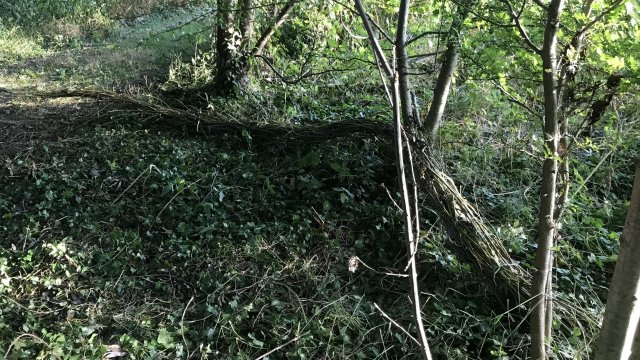
But this vascular system also made me think of the fibres along which the Internet connects the world. These tightly strung bundles snaking through the saplings begin to split apart into thicker woody branches as they reach the middle section.
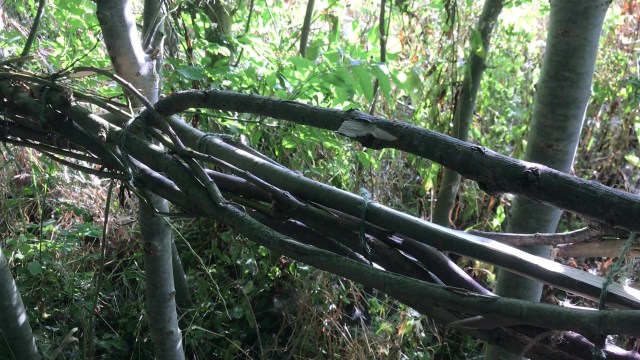
The central section is a more complex ‘flowering’ stage. The shapes I was ‘drawing’ were initially inspired by the lay of the landscape beyond, with its runs of fields and hedge boundaries. I used thin ash branches that littered the floor below the young trees.

These had become my supporting uprights through which increasingly fanciful organic shapes were woven. The ash branches had a particularly pronounced curve, which often resulted in an almond shape. Fringed with sticks I imagined the largest to represent a micro-organism or maybe an eye through which to view the landscape, depending on the scale.

I’d wanted to introduce colour to this section and diverted from my on-site materials by using cotton muslin coloured with natural organic dyes made from onion skins, tea and turmeric, which gave the variety of ochres and yellows I saw on the land.

Sunlight, at times, glows through the muslin with great intensity. The effect is almost that of an ecclesiastical stained-glass window. I allowed the coloured membranes to rise to an apex, further suggesting a church-like atmosphere.
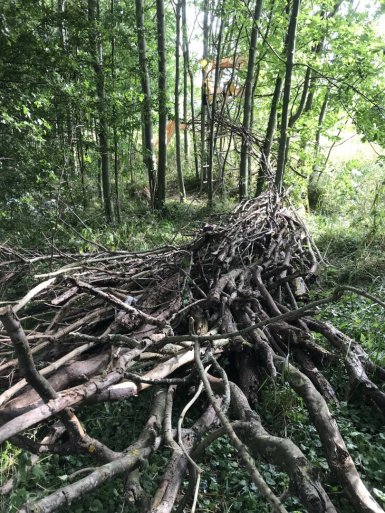 The third section is about the entropic nature of life – its cyclical dissolution and decay. In contrast to the fragile pictorial formations of the central section, the third part of the installation has a much darker, weightier, more threatening feel.
It could be read as a raft of roots growing through the trees, but I reversed the scale of branches and logs, flowing away from the centre and towards the viewer to imply a great wave of energy released into a cataclysm flooding the woodland.
This section highlights the latent power of the natural world – something that we ignore at our peril.
‘The Green Fuse‘ is part of the ‘Living Landscape’ Arts Trail, curated by Angie Atmadjaja and Rebecca Blackwood at The HopBarn in Nottinghamshire, open to visitors from 1 Sept to 28 Nov 2021.

 Susan Isaac - Paintings & Sculpture